PDRN and Spicule Serums, Explained: An Ingredient Guide Without the Hype
Two ingredient names are dominating K-beauty right now: PDRN, marketed as "salmon DNA," and spicules, marketed as "liquid microneedling." The ads promise clinic-level results from a bottle. Before you spend money, it helps to know what these ingredients literally are, where they came from, and what the evidence can and cannot support for a product you rub on your face.
This is an ingredient-education guide, not a product review and not a promise. The short version: PDRN is a real substance with a medical history in Korea — as an injection. Spicules are real microscopic structures with a plausible delivery mechanism — and a real irritation profile. What is genuinely uncertain is how much of either story survives the move from clinic to cosmetic jar.

PDRN starts with salmon — the DNA fragments used in Korean clinics and, now, in cosmetic serums.
What is PDRN, actually?
PDRN stands for polydeoxyribonucleotide: short fragments of DNA, typically extracted and purified from salmon (sometimes trout) sperm cells. In South Korea, PDRN has a long history in regulated medical settings — it is the active component in injectable "skin booster" treatments administered in clinics, and PDRN preparations have also been used in wound-care contexts under medical supervision.
Cosmetic PDRN serums borrow that name and that origin story. On an ingredient list, you will usually see it as "Sodium DNA." What changes between the clinic and the bottle is everything else: the concentration, the purity standard, the delivery method (a needle places it under the skin; a serum sits on top of it), and the regulatory category — a cosmetic is not a drug and is not evaluated as one.
What does the evidence for topical PDRN show — and not show?
Here is the honest state of play:
- Most published PDRN research concerns injected or medically applied preparations, not over-the-counter creams. Results from a clinic syringe do not automatically transfer to a serum.
- DNA fragments are large molecules, and large molecules penetrate intact skin poorly. This is the central unanswered question for topical PDRN: how much, if anything, gets through the skin barrier in a cosmetic formula.
- Small cosmetic studies and manufacturer data suggest moisturizing and skin-conditioning effects are plausible — as they are for many film-forming, hydrating ingredients.
So a fair reading is: PDRN in a serum is not magic water, but it is also not proven to reproduce clinic outcomes. Treat it as a hydrating, conditioning ingredient with an interesting pedigree and a thin topical evidence file — and price it accordingly. This is the same label-first skepticism we recommend for overnight products in Korean Sleeping Masks: What They Do and How to Use One Overnight.
What are spicules, then?
Spicules in skincare are microscopic, needle-shaped structures of silica obtained from freshwater sponges (commonly Spongilla lacustris), listed on labels as "Hydrolyzed Sponge." When a spicule serum is massaged in, the tiny spicules lodge superficially in the outer skin layer and gradually shed over a day or two. The tingling or prickling sensation people report is the spicules themselves — it is expected with this category, within limits.
The proposed purpose is delivery: the micro-channels created by the spicules are intended to help other ingredients in the formula absorb better, which is why spicules are so often combined with ingredients like PDRN, peptides or niacinamide in a single "booster" serum.

Spicules under magnification: tiny silica needles from freshwater sponge — the tingle is the ingredient itself.
Key points
- PDRN = purified DNA fragments, usually from salmon. Its track record is mainly in Korean clinic injections, not jars.
- Topical PDRN evidence is limited; large molecules penetrate intact skin poorly, so clinic results do not transfer automatically.
- Spicules = microscopic silica needles from freshwater sponge ("Hydrolyzed Sponge" on labels). A prickly tingle is normal for the category.
- Both categories call for patch testing and schedule discipline — spicules especially are not an everyday, layer-with-everything ingredient.
- On labels: look for "Sodium DNA" (PDRN) and "Hydrolyzed Sponge" (spicules) to know what you are actually buying.
What are the cautions for spicule serums?
Because spicules work by physically lodging in the outer skin layer, the caution list is longer than for an ordinary serum:
- Start low and slow. Once or twice a week is a sensible introduction, not nightly from day one. Tingling should fade; burning, swelling or a rash is a stop signal, not a "purge."
- Do not stack aggressively. On spicule nights, skip strong exfoliating acids and go gently with retinoids until you know your tolerance.
- Broken or flaring skin is a no. Avoid spicules on sunburned, eczema-flaring, freshly exfoliated or otherwise compromised skin.
- Sensitive and rosacea-prone skin should be especially careful — deliberate micro-irritation is the mechanism, and reactive skin may simply not enjoy it.
- Press, don't scrub. Aggressive rubbing increases irritation without improving anything.
Patch-test any new active-style serum on a small area for a few days first — the same habit we teach for scalp treatments in our Korean scalp care routine, where an ingredient's strength showed up as sensation, too.
How do you shop this category with clear eyes?
Three label habits will serve you better than any influencer ranking:
- Find the ingredient's actual name. "Salmon DNA serum" with no Sodium DNA on the list is a theme, not a formula.
- Notice what is not disclosed. Cosmetics rarely publish PDRN concentrations, so compare formulas by their overall ingredient quality — humectants, barrier support, fragrance load — rather than by one headline ingredient. Our K-beauty beginner routine covers the dependable basics that do most of the real work in any routine.
- Buy the trial size first. Both categories are expensive per bottle, and both are divisive — your skin's verdict in a week of patch testing is worth more than a hundred reviews.

Blank-label thinking: judge the formula as a whole, not the one trending word on the box.
Bottom line: PDRN and spicules are genuinely interesting ingredients with real origins — a clinic injectable's chemistry and a sponge's microscopic needles. In cosmetic form, the evidence is thinner than the marketing, so the smart approach is curiosity plus discipline: verify the ingredient is actually present, patch-test, introduce slowly, and let your own skin, not the hype cycle, decide whether to repurchase.
Have you tried a spicule serum — was the tingle a deal-breaker or no big deal? And did the PDRN name on the label turn out to be Sodium DNA in the ingredient list?
Sources: Korean Ministry of Food and Drug Safety (MFDS) cosmetic ingredient listings for Sodium DNA and Hydrolyzed Sponge; published literature on polydeoxyribonucleotide in medical and wound-care settings (reviews in Journal of Clinical Medicine and related journals); cosmetic science reviews of sponge spicule delivery systems and skin penetration of large molecules.
Disclaimer: This article is ingredient education for general information only. It is not medical or dermatological advice, and it makes no claim that any cosmetic product treats, cures or changes the structure of skin. Stop using any product that causes persistent irritation, and consult a dermatologist about ongoing skin concerns, especially if you have eczema, rosacea or other diagnosed skin conditions.
Version française: Sérums au PDRN et aux spicules : le guide des ingrédients, sans le battage
One example of the label habit in this guide
This guide is not a product review, so this is only an example of the first label habit above: the medicube PDRN Pink Peptide Ampoule lists PDRN (Sodium DNA) 1% and a 5-type peptide complex on its bottle, in a 30 ml bottle sold as a set with a refill. It is a PDRN serum, not a spicule one — so the patch-test and start-slow rules above still apply, and it does not replace the rest of the routine.
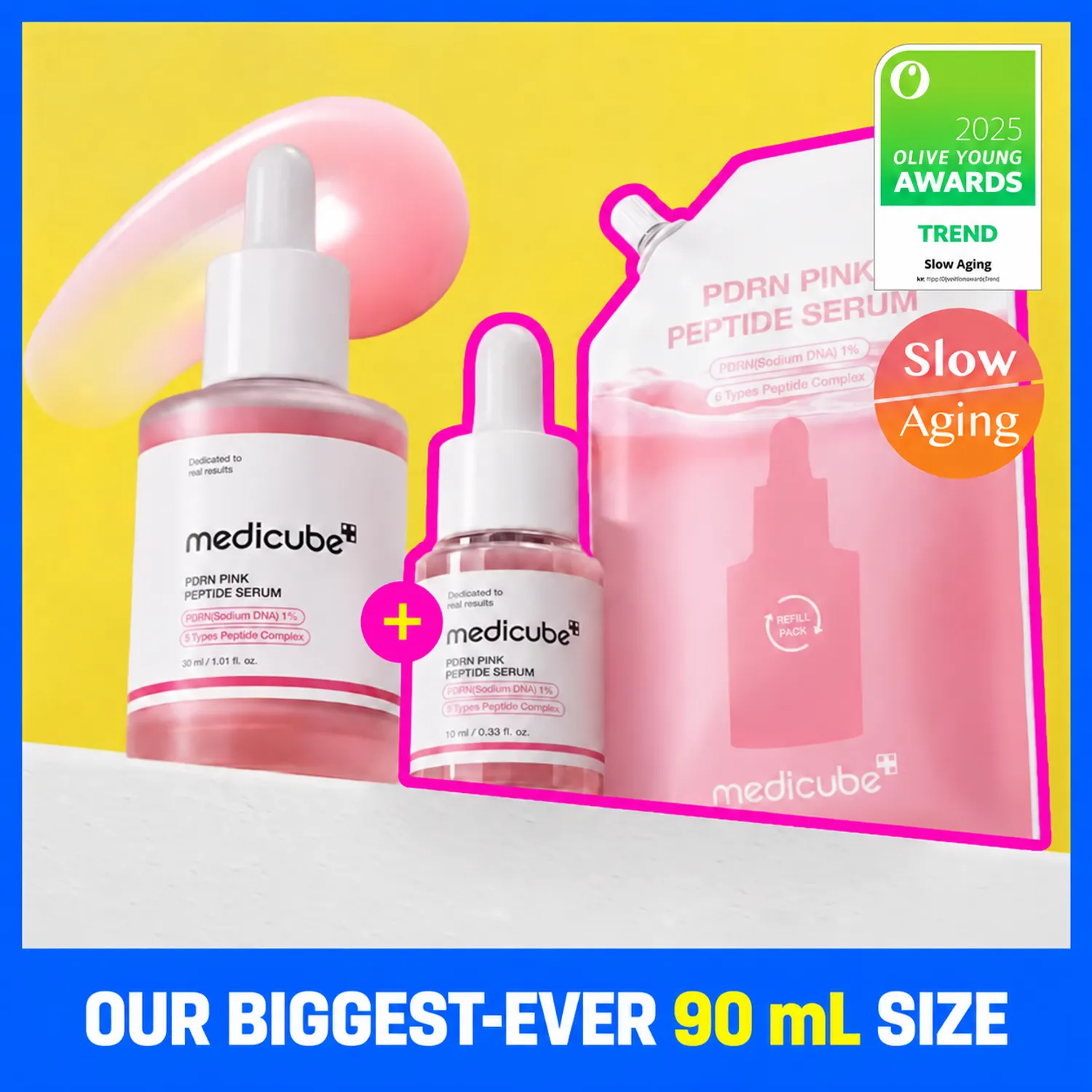
medicube PDRN Pink Peptide Ampoule, 30 ml, with refill — PDRN (Sodium DNA) 1% stated on the label (photo: OLIVE YOUNG Global).
Worth knowing
- Good: the concentration is stated on the label (Sodium DNA 1%), which is the check this guide asks for, and the set gives you a 30 ml bottle plus a refill rather than a single bottle.
- Keep in mind: it is sold in a set with a refill, so check which option you are ordering — and keep the patch-test-first rule in this guide before using it regularly.
For readers in Canada, this is a Canada-shipping route: orders ship from Korea by FedEx and usually arrive in 8–11 days, with free shipping on orders over US$60. Orders over CA$20 may be taxed on delivery. This route does not currently ship to the United States.
You can see it at OLIVE YOUNG Global here: medicube PDRN Pink Peptide Ampoule on OLIVE YOUNG Global. Use code VITAGUIDE1 for 5% off — it cannot be combined with other coupons.
Disclosure: this post contains an affiliate link. If you buy through it, I may earn a commission at no extra cost to you.


댓글
댓글 쓰기