Korean Sleeping Masks: What They Do and How to Use One Overnight
You do your full evening routine — cleanse, tone, serum, moisturizer — and by 3 a.m. your skin still feels tight, especially in winter when indoor heating runs all night. Korean skincare has a specific product category built for exactly that gap between your last evening step and your morning wash: the sleeping mask.
The short version: a sleeping mask (also called an overnight mask or sleeping pack) is a gel-cream you apply as the final step of your night routine and rinse off in the morning. It is not a sheet mask and not a wash-off mask. Its job is simple — sit on top of everything else, slow down overnight water loss, and let you wake up with skin that feels less parched. Here is how to choose one and use it without turning your pillow into part of the routine.

A sleeping mask lives on the nightstand, not the treatment shelf — it is the last thing on, the first thing rinsed off.
What is a sleeping mask, exactly?
Think of it as a seal, not a treatment. A regular moisturizer is formulated to absorb. A sleeping mask is formulated to stay — a slightly more occlusive layer that reduces transepidermal water loss while you sleep, so the hydrating layers underneath (your toner, essence and serum) keep working instead of evaporating into dry bedroom air.
Textures split into two families. Gel types feel watery and light, suit oily and combination skin, and absorb enough that they barely feel present. Cream types are richer, suit dry and dehydrated skin, and leave a more noticeable film. If you are new to the category, our K-beauty beginner routine shows where a sleeping mask slots in — it replaces nothing; it goes on top, two or three nights a week at first.
Which ingredients are worth looking for?
Ignore the artwork on the jar for a moment and read the ingredient list. The useful names in a sleeping mask are mostly humble:
- Humectants — glycerin, hyaluronic acid, beta-glucan: draw water into the upper layers of skin.
- Barrier lipids — ceramides, squalane, panthenol (vitamin B5): support the skin barrier and reduce overnight moisture loss.
- Soothing staples — centella asiatica (cica), aloe, green tea: common in Korean formulas for calming the look of redness.
- Light occlusives — dimethicone and similar silicones: create the breathable film that does the actual "sealing."
A formula does not need all of them. For dry winter skin, a humectant-plus-ceramide combination is the workhorse pairing. For oily skin, a humectant gel with panthenol usually feels better than a rich cream.
How do you use one, step by step?
- Do your normal evening routine up to moisturizer.
- Wait a minute or two so the layers underneath settle.
- Apply a pea-to-coin-sized amount of sleeping mask over your whole face, avoiding the immediate eye area.
- Give it 10–20 minutes before bed so most of it sets — this is the step that saves your pillowcase.
- In the morning, rinse with lukewarm water or cleanse gently as usual.
Key points
- A sleeping mask is the final step of the night routine — a seal over your other layers, not a replacement for moisturizer.
- Gel textures suit oily/combination skin; cream textures suit dry/dehydrated skin.
- Look for glycerin or hyaluronic acid (hydration) plus ceramides, squalane or panthenol (barrier support).
- Start with 2–3 nights a week; daily use is fine for many dry skin types if the formula is bland.
- Apply it 10–20 minutes before bed to keep it off the pillow.

Most sleeping masks are gel-creams — that watery, slow-to-absorb texture is deliberate, not a flaw.
How often should you use one?
Twice or three times a week is the standard starting point, and it is enough for most people to notice a difference on waking. Very dry or winter-stressed skin may tolerate nightly use of a gentle formula. Oily and acne-prone skin usually does better with a gel type, a thin layer, and fewer nights — a heavy occlusive layer every night can feel congesting.
One practical pairing rule: on nights you use strong actives (a retinoid or a strong exfoliating acid), a bland sleeping mask on top can be a comfort layer — but if your skin is reactive, alternate instead: actives one night, sleeping mask the next. Our guide to Korean scalp care makes the same point for hair and scalp: in K-beauty, the schedule matters as much as the product.
Who should choose carefully — or skip it?
- Sensitive or fragrance-reactive skin: many sleeping masks are fragranced. Look for fragrance-free versions and patch-test on the jawline for a few nights first.
- Very oily skin in humid weather: you may simply not need the extra layer; a good moisturizer alone can be enough.
- Anyone mid-flare-up: if your skin is actively irritated, broken or sunburned, park the extras and keep the routine minimal until it calms down.
And a worthwhile habit for any trendy ingredient category: read what is actually in the jar rather than what the marketing calls it — the same skeptical approach we take in PDRN and Spicule Serums, Explained: An Ingredient Guide Without the Hype.

A shelf of options is nice — but one mask matched to your skin type beats three matched to trends.
Bottom line: A sleeping mask is the simplest upgrade in Korean skincare: a sealing layer, chosen by texture for your skin type, used a few nights a week. Pick humectants plus barrier lipids, keep the layer thin, and let consistency do the work.
Are you team gel or team cream when it comes to overnight masks — and how many nights a week do you actually use one?
Sources: Ingredient and product-category references: Korean cosmetic ingredient dictionary (KCII) listings for humectants and barrier lipids; published reviews of transepidermal water loss and occlusive moisturizers in the Journal of Clinical and Aesthetic Dermatology; manufacturer usage guidance from major Korean sleeping mask lines (Laneige, COSRX) as category examples.
Disclaimer: This article is for general information only and is not medical or dermatological advice. Cosmetic products affect people differently; stop using any product that causes persistent irritation and consult a dermatologist about ongoing skin concerns.
Version française: Les masques de nuit coréens : à quoi ils servent et comment les utiliser pendant la nuit
One gel-cream example of the format in this guide
If you go with a gel type, as this guide suggests for oily or combination skin, the LANEIGE Water Sleeping Mask is an example of that format: a 70 ml gel-cream in a jar, sold as a set with a trio of mini sleeping masks. It goes on as the last step, two or three nights a week, as described above.
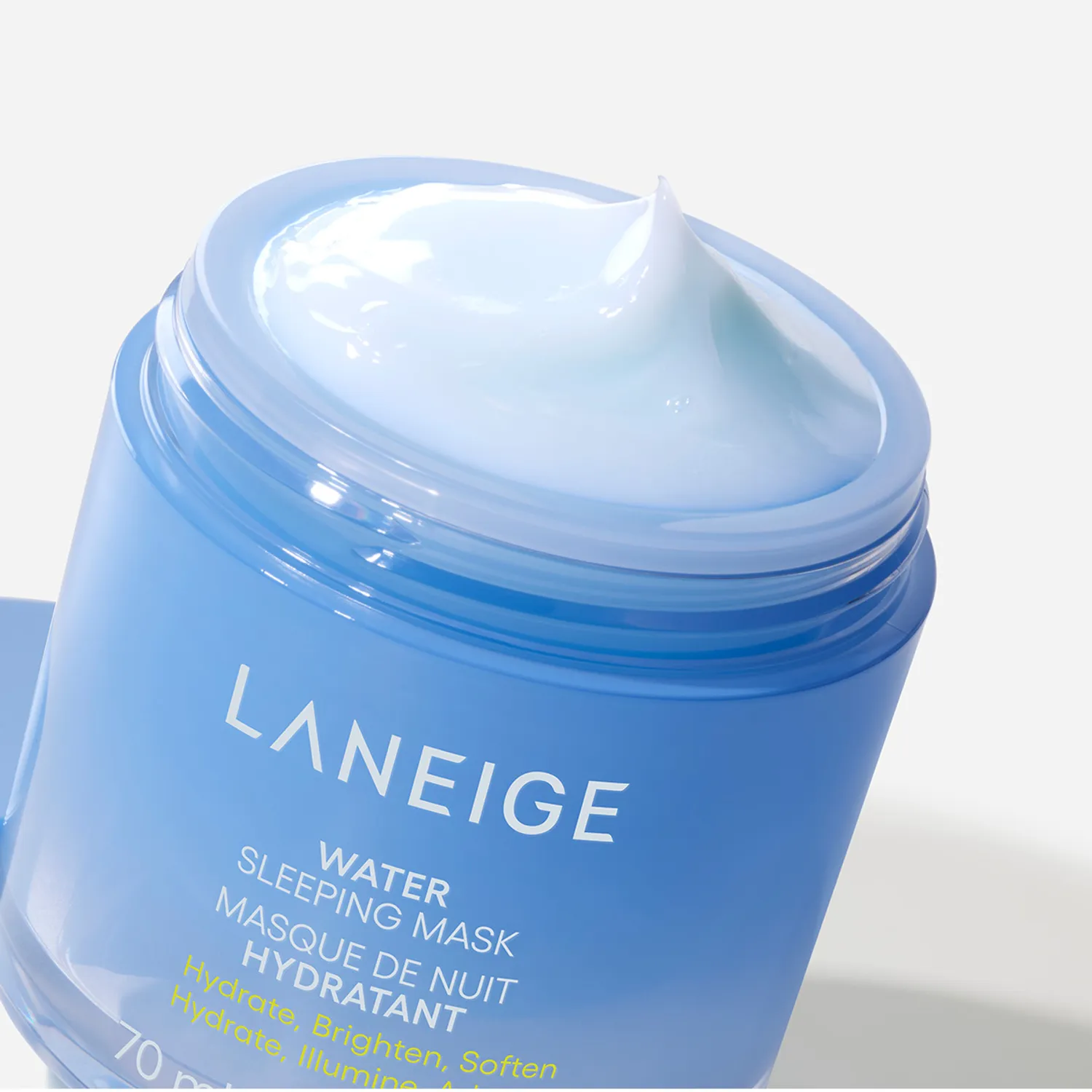
LANEIGE Water Sleeping Mask, 70 ml — in a set with a Sleeping Mask Mini Trio (photo: OLIVE YOUNG Global).
Worth knowing
- Good: the gel-cream texture is the light type described in this guide, and a 70 ml jar lasts a while at two or three nights a week.
- Good: the mini trio in the set lets you try other sleeping masks in the line without buying three jars.
- Keep in mind: it is a jar to dip into — use clean hands — and keep the two-or-three-nights-a-week frequency from this guide rather than starting every night.
For readers in Canada, this is a Canada-shipping route: orders ship from Korea by FedEx and usually arrive in 8–11 days, with free shipping on orders over US$60. Orders over CA$20 may be taxed on delivery. This route does not currently ship to the United States.
You can see the set at OLIVE YOUNG Global here: LANEIGE Water Sleeping Mask on OLIVE YOUNG Global. Use code VITAGUIDE1 for 5% off — it cannot be combined with other coupons.
Disclosure: this post contains an affiliate link. If you buy through it, I may earn a commission at no extra cost to you.


댓글
댓글 쓰기