Korean Rice Skincare Explained: Rice Water, Rice Extract and How to Use Rice Toners Without Overdoing It

Rice is suddenly in every toner — but what does "rice" on a label actually mean?
If you have browsed K-beauty shelves lately, you have probably noticed rice everywhere: rice toners, rice essences, rice creams, rice masks. The ingredient sounds simple and comforting — it is food, after all — but the word "rice" on a cosmetic label can mean at least four quite different things, and they are not interchangeable. A toner made with traditional rice water is not the same product as one built on a standardized rice extract, and a fermented rice formula behaves differently again.
Here is the short answer first. In K-beauty, "rice" usually refers to ingredients derived from Oryza sativa — the rice plant — listed on ingredient labels under that Latin name. Rice water is the starchy water left over from rinsing or soaking rice. Rice extract is a processed ingredient made from the grain itself. Rice bran extract comes from the outer layer of the grain. Fermented rice is rice broken down with the help of yeast or bacteria. Brands formulate these ingredients mainly for hydration and for helping skin feel smoother and more even in texture. What rice skincare does not do is treat a medical skin condition, and this guide will not claim otherwise — the honest value of rice in skincare is gentle, moisturizing, texture-focused care.
Version française : Les soins coréens au riz expliqués : eau de riz, extrait de riz et comment utiliser les toners au riz sans en abuser
The four kinds of "rice" you will see on a label
1. Rice water — the traditional starting point
Rice water is exactly what it sounds like: the cloudy, starchy water produced when rice is rinsed or soaked. It has been used traditionally in Korea, Japan and China for washing the face and hair, long before bottled toners existed. In a commercial product, "rice water" may be an actual ingredient or part of the product's concept, so check the ingredient list to see where it sits and what else is in the formula.
2. Rice extract — the standardized version
Rice extract is made by processing the rice grain to draw out soluble components, then stabilizing the result so it can be used consistently in cosmetics. On an INCI ingredient list you will see it as Oryza Sativa (Rice) Extract. This is the form most modern K-beauty toners and essences rely on, because a manufacturer can control its concentration and quality from batch to batch in a way that kitchen rice water never allows.
3. Rice bran extract — from the outer layer
Rice bran is the thin outer layer removed when brown rice is polished into white rice. It is listed as Oryza Sativa (Rice) Bran Extract, and it is the part of the grain associated with rice bran oil and with compounds such as gamma-oryzanol and ferulic acid. Because bran is oilier and richer than the starchy grain interior, bran-based ingredients show up more often in creams and richer essences than in watery toners.
4. Fermented rice — rice, broken down
Fermented rice ingredients are produced by fermenting rice with yeast or bacteria, which breaks larger molecules into smaller ones. Labels may list them as a ferment filtrate or a ferment extract, sometimes alongside the Oryza sativa name. Fermentation is a long-standing technique in Korean skincare, and fermented rice ingredients are typically positioned for hydration and skin texture. As with every ingredient here, the exact result depends on the finished formula, not on the word "fermented" alone.
A quick label tip: if a product markets itself as a "70% rice" toner, that percentage refers to the brand's rice ingredient or rice line concept as the brand defines it — it does not mean 70% of the bottle is plain rice from a kitchen. Always read the INCI list for the Oryza sativa entry and its position.

What is actually in rice, according to the ingredient science?
Rice and rice bran contain a mix of components that cosmetic formulators find useful. The ones most often discussed are:
- Amino acids — the building blocks of proteins, used in skincare as humectant and conditioning components that support a comfortable, hydrated feel.
- B-group vitamin related compounds — rice is a natural source of several B vitamins in food, and related compounds appear in cosmetic formulas as skin-conditioning ingredients.
- Ferulic acid — an antioxidant compound found in rice bran, widely used in cosmetic formulations.
- Gamma-oryzanol — a mixture of compounds naturally present in rice bran oil, long used in Japanese and Korean cosmetics.
Two honest cautions belong here. First, the amount and form of each component differ enormously from product to product — a trace of rice extract at the end of an ingredient list is not the same as a formula built around it. Second, "contains an antioxidant ingredient" describes what is in the bottle; it is not proof that a cosmetic will change your skin the way a medicine would. Rice ingredients are traditionally used, and are formulated today, for moisture and for helping skin feel smoother and look more even in texture. That is a reasonable expectation. Anything stronger would be a claim this guide will not make.
The product types you will meet — and how to use each one
- Milky toner: A slightly thick, opaque toner — the most common rice format. After cleansing, pour a small amount into your palms, spread it between your hands, and press it gently over your face. Skip the cotton pad; palms waste less product and press the toner in rather than wiping it away.
- Essence: A step between toner and serum, usually a little more concentrated. Apply the same way, with palms, after toner.
- Cream: A rice or rice bran cream works as the moisturizing final step, especially in the evening or in dry weather.
- Wash-off mask: A rinse-off format — sometimes a soft rice powder or a creamy mask — used once or twice a week and removed after the time stated on the package.
How much layering is enough?
Korean skincare is famous for layering, and rice toners invite it because they feel so comfortable. Keep it simple: one to two layers of toner is plenty for most people. If your skin feels coated, tacky for a long time, or starts to look congested, you have passed your skin's limit — go back to a single layer. More layers do not multiply the benefit; they mostly multiply the chance of irritation from everything else in the formula, such as fragrance or preservatives.
At a glance — rice skincare without overdoing it
- "Rice" on a label can mean rice water, rice extract, rice bran extract, or fermented rice — check for Oryza sativa in the INCI list.
- Milky toner: pour into palms, press on after cleansing, 1–2 layers maximum.
- New product? Patch test first, and give it a week before judging.
- Always finish the morning with sunscreen.
- DIY rice water goes off fast — a tested commercial product is the safer everyday choice.
A word of honesty about DIY rice water
Because rice water starts in the kitchen, it is tempting to make your own. If you do, treat it like food, not like a cosmetic. Homemade rice water has no preservative system, and rice water left at room temperature to "ferment" can grow bacteria and mould quickly — that is a real contamination risk, not a theoretical one. If you try it at all: make a small amount, refrigerate it, use it the same day or within a very short period, and throw it away at any sign of sour smell or change. Never store it on the bathroom counter for a week.
For daily use, a commercially made rice toner is simply the more realistic option. It has been formulated for stability, preserved properly, and tested as a finished product. There is no shame in choosing the bottle over the rice cooker — that is what the bottle is for.

Which skin types get along with rice toners?
- Dry skin: Usually the best match. Milky rice toners add a layer of moisture under cream, and rice bran creams suit dry, tight-feeling skin well.
- Normal and combination skin: A single pressed-on layer is typically enough; add a second layer only on drier areas such as the cheeks.
- Oily skin: Choose a lighter, watery rice toner rather than a milky one, and use one thin layer. A rich milky formula can feel heavy by midday.
- Sensitive skin: Rice itself is considered a gentle ingredient, but the rest of the formula decides how your skin reacts. Check for fragrance and drying alcohol on the label, patch test on a small area for a few days, and introduce one new product at a time so you know what caused any reaction.
Whichever type you have, two rules stay the same: patch test every new product, and wear sunscreen during the day. No toner replaces sun protection.
Frequently asked question
Can I use a rice toner every day, morning and night? For most people, yes — a gentle rice toner is designed for daily use, once or twice a day, in one or two thin layers. If your skin starts to feel irritated, tight or congested, cut back to once a day and check what else changed in your routine at the same time, because the newest product is not always the culprit.
Related reading
- Toner Pads Explained: How to Use Them Without Irritating Your Skin
- K-Beauty Sunscreen Guide: How to Choose the Right SPF for Your Skin Type
One rice toner that fits this guide
If you want a concrete example of the milky toner described above, the Anua Rice 70 Glow Milky Toner (250 mL) is built around Anua's rice line concept and is used exactly the way this guide recommends — poured into the palms and pressed onto the skin after cleansing.
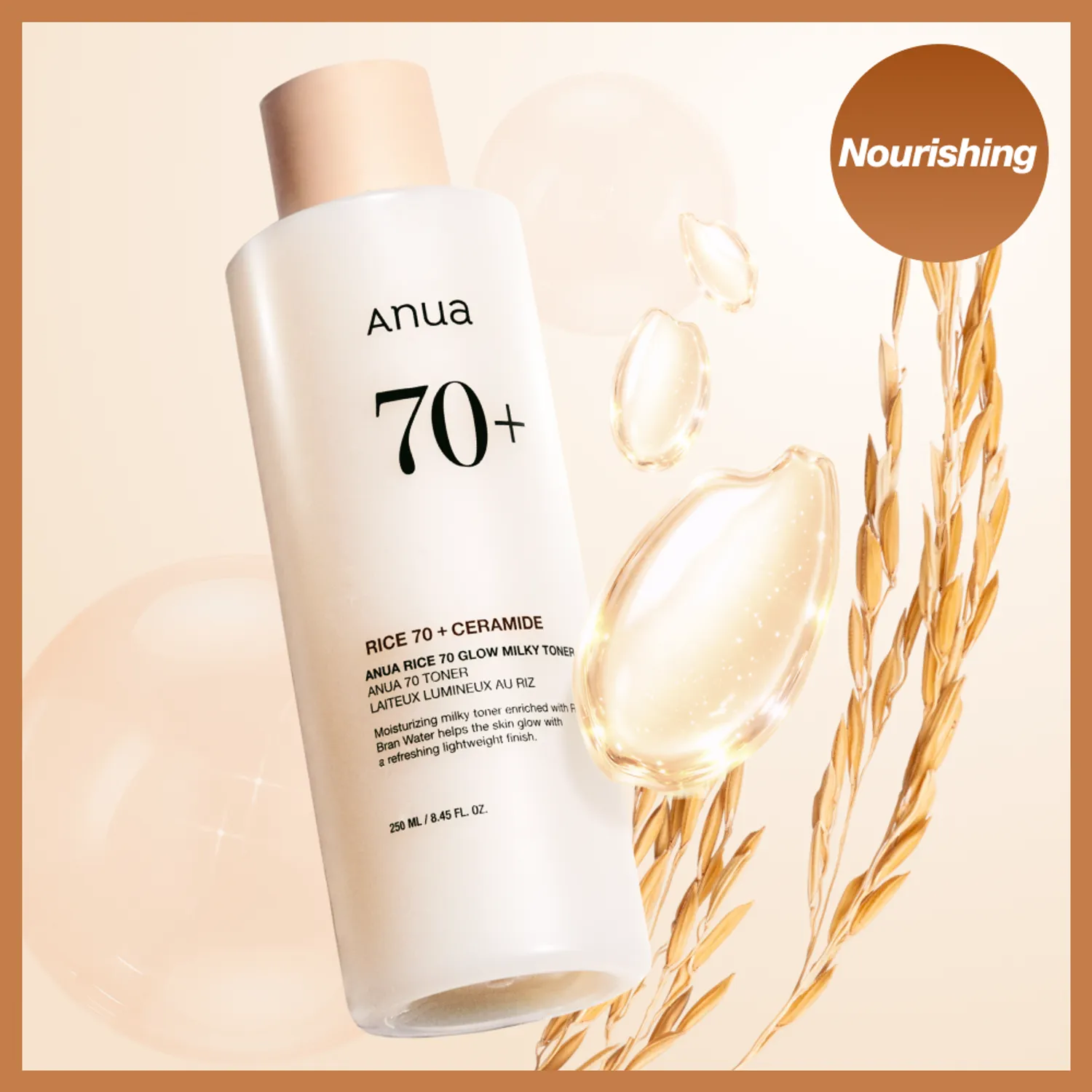
What we like:
- A generous 250 mL bottle, so daily palm application does not run out in a few weeks.
- A milky texture that gives dry and normal skin a comfortable layer of moisture before cream.
- A clear, single-ingredient story — the Rice 70 line concept — that makes the label easy to understand.
What to know before buying:
- The milky texture can feel heavy on very oily skin, especially in humid weather.
- As with any fragranced or multi-ingredient formula, check the full ingredient list against your own sensitivities before ordering.
Buy it on OLIVE YOUNG Global: OLIVE YOUNG Global — Get 5% off with reward code VITAGUIDE1 at checkout; the code cannot be combined with other coupons.
Shopping from Canada: orders ship from Korea via FedEx and arrive in 8–11 days, with free shipping on orders over US$60. Orders over CA$20 may be charged tax on delivery. Please note that shipping to the United States is not currently available.
This post contains affiliate links. If you buy through them, we may earn a commission at no extra cost to you.
Have you tried a rice toner — and did you apply it with a cotton pad or with your palms? Tell us in the comments; the palm-versus-pad debate is a friendly one, and we read every answer.
Follow Daily Vitamin & Health Guide to catch new K-beauty ingredient guides as soon as they are published — the follow button is in the sidebar.
Disclaimer: This article is for general information only and is not medical advice. Cosmetic products do not treat skin diseases, results vary by person, and any new product can cause irritation — patch test first. If you have a skin condition or a persistent concern, please consult a dermatologist or healthcare professional.
Sources: Ingredient information based on standard INCI nomenclature for Oryza sativa (rice) extract and Oryza sativa (rice) bran extract as used in cosmetic ingredient references (CosIng, the European Commission's cosmetic ingredient database), and on published cosmetic-science reviews of rice and rice bran components such as ferulic acid and gamma-oryzanol. Product details for the Anua Rice 70 Glow Milky Toner are from the brand's official product information as listed on OLIVE YOUNG Global, checked November 2026.


댓글
댓글 쓰기