Korean Collagen Masks Explained: Hydrogel vs Sheet Masks, What They Actually Do, and How to Use Them

Two very different mask formats, one similar goal — helping your skin surface hold on to water for a little while.
Standing in the mask aisle, wondering what “collagen mask” even means?
If you have ever scrolled past a video of a clear mask slowly turning transparent overnight, or stood in front of a wall of Korean masks trying to choose between a foil packet and a two-piece gel mask, you are not alone. The names sound similar, the packaging all promises glow, and the word “collagen” does a lot of heavy lifting. It is easy to buy three different types, use them all the wrong way, and conclude that masks simply do not work for you.
Here is the honest summary first: a collagen mask is mainly a short, intensive hydration step. The collagen in the formula is generally understood in cosmetic science to sit on the surface of the skin, where it helps hold water and forms a light, flexible film. That can make skin look temporarily smoother, plumper, and more comfortable after use — but it is not the same thing as rebuilding the collagen inside your skin. Once you understand that, choosing between a sheet mask and a hydrogel mask becomes much simpler: it comes down to fit, wear time, cost, and how you like to use them.
What are the two main types of collagen masks?
Korean collagen masks usually come in two formats. Many products use the same kinds of supporting ingredients, so the format itself changes the experience more than the word “collagen” on the front.
Sheet masks — essence-soaked, single use
- Material: a thin sheet made from cotton, cellulose, or bio-cellulose, soaked in a watery essence
- Fit: draped over the face, with cut-outs for the eyes, nose, and mouth — fit varies a lot by brand
- Wear time: typically 10–20 minutes, following the directions on the packet
- Feel: cool and wet at first, quick and convenient, easy to find in multi-packs
- Cost and waste: usually lower cost per use, but each mask creates single-use packaging and sheet waste
- Important limit: remove it on time — do not leave it on until it dries out
Hydrogel masks — gel matrix, often in two pieces
- Material: a soft, jelly-like gel that holds essence inside its structure
- Fit: often sold as two pieces — one for the upper face and one for the lower face — so it adheres closely and can be adjusted around the jaw and cheeks
- Wear time: typically 20–40 minutes for standard types, following the product's own instructions
- Overnight types: some hydrogel masks are designed to be worn for longer periods, sometimes overnight, and they turn more transparent as the essence is absorbed into the skin surface — only use a mask this way if that specific product is made and labelled for it
- Feel: firmer contact, less dripping once it settles, often feels more “set” on the skin
- Cost and waste: usually higher cost per use than a basic sheet mask, with a closer fit as the trade-off
Neither format is automatically better. A sheet mask suits a quick, lower-cost hydration step before an event or at the end of a long day. A hydrogel mask suits someone who wants closer contact, a longer wear time, and does not mind paying a little more per session.

The two-piece design is the hydrogel difference — closer contact around the cheeks and jaw, if you take a minute to align it well.
What does collagen in a mask actually do?
This is the section most marketing skips, so it is worth reading carefully.
Collagen is a large protein. In its full form, its molecules are too large to simply pass through the outer layer of skin and slot into the skin's own support structure. That is why cosmetic science generally treats collagen in a rinse-off or short-contact product like a mask mainly as two things:
- A humectant-like helper: it helps the surface of the skin hold on to water during and shortly after use
- A film-former: it leaves a very light, flexible film that can make the surface feel smoother to the touch
The visible result people describe — skin that looks a bit plumper, feels less tight, and takes makeup more evenly — is best understood as a hydration and appearance effect. It is temporary, and it fades as the water on the surface evaporates or is washed away. A mask does not rebuild your skin's own collagen, does not remove wrinkles, and is not a medical treatment.
You will also see hydrolyzed collagen on many ingredient lists. “Hydrolyzed” simply means the collagen has been broken down into smaller fragments during manufacturing. Those smaller pieces are common in cosmetics because they mix more easily into essences and gels. The term describes the size and form of the ingredient — on its own, it is not a guarantee of a stronger or longer-lasting result.
In short: expect a collagen mask to be a good hydration step with a pleasant, short-term smoothing effect. Judge it on that basis, and it is much easier to tell whether a particular product was worth its price.
Which supporting ingredients are usually paired with collagen?
Collagen is rarely the only name on the label. These are the ingredients most commonly paired with it in Korean masks, described the way cosmetic ingredient references generally describe them:
- Hyaluronic acid: a well-known humectant used in cosmetics to help the skin surface hold water
- Niacinamide: a form of vitamin B3 widely used in skincare formulas, including in products aimed at an even-looking skin tone
- Panthenol: also known as provitamin B5, commonly used in formulas designed to feel soothing and comfortable on the skin
- Ceramides: lipids that are also naturally present in the skin barrier, included in many moisturizing formulas
A longer ingredient list is not automatically a better mask. If your skin is reactive, a shorter, simpler formula you have patch tested is often the wiser starting point than the mask with the most active-sounding names.
A quick summary before you use one
- Collagen in a mask mainly helps the surface hold water
- The smoothing, plumping look is temporary — it is a hydration effect
- Sheet masks: 10–20 minutes, lower cost, more waste
- Hydrogel masks: 20–40 minutes, closer fit, higher cost
- Always finish with moisturizer to seal in the essence
- Patch test a new mask first
How do you use a collagen mask, step by step?
Technique matters more than most people expect. A mask used at the wrong step, or left on too long, gives a much weaker result than the same mask used as directed.
- Cleanse. Start with clean skin so the essence is not sitting on top of makeup, sunscreen, and the day's buildup.
- Apply toner. A light toner step, patted on while skin is still slightly damp, is the usual preparation in a Korean routine.
- Apply the mask. Unfold it carefully, align the eye and mouth openings first, then smooth it outward. Press out air bubbles with clean fingertips — for a hydrogel mask, place the lower piece first, then the upper piece, and adjust the edges around the nose and jaw.
- Wait for the directed time only. Follow the time printed on that product. Set a timer if you tend to get distracted.
- Remove and pat in. Peel the mask off gently and pat the remaining essence into your skin with your palms. There is usually no need to rinse unless the product tells you to.
- Seal with moisturizer. This is the step people skip — and it matters. A moisturizer on top helps slow down how quickly that water leaves the surface.
- Add sunscreen in the daytime. If you mask in the morning, sunscreen is your final step before going out.
Many labels suggest using a mask 1–3 times a week rather than daily. Treat that as a starting guide from the manufacturer, not a rule you need to push past — more frequent use is not automatically better, especially for sensitive skin.

The last two steps decide how long the effect lasts — pat the essence in, then seal it with moisturizer.
What are the most common collagen mask mistakes?
Leaving a sheet mask on until it dries. This is the most common error. Once a sheet starts to dry, it can begin to draw moisture back from the surface of your skin instead of adding it. A mask that feels “fully used” because it is crisp and dry has usually been on too long.
Skipping moisturizer afterwards. Essence alone evaporates quickly. Without a moisturizer to seal it in, much of the benefit of a 20-minute mask can be gone within the hour.
Using a mask every single day, right away. Starting daily, with a brand-new product, gives your skin no time to tell you whether it likes the formula. Begin once or twice a week and watch how your skin responds.
Stacking a first-use mask with strong actives. As a general caution, if your skin is sensitive, avoid trying a new mask for the first time on the same night as a retinoid or a high-strength acid product. Introduce one new thing at a time so you know what caused any irritation.
Skipping the patch test. Test a new mask's essence on a small area first, and stop using it if you notice irritation, itching, or a rash. Store masks at room temperature, away from direct sunlight, and use a single-use mask promptly once the packet is open.
Frequently asked question
Can I reuse a sheet mask or hydrogel mask to save money?
No — both formats discussed here are designed and sold as single-use products. Once a mask has been on your face, re-soaking and reusing it is not hygienic, and the essence left in the packet is not a substitute for a fresh mask. If cost is the concern, a basic sheet mask in a multi-pack is usually the more economical way to keep the same routine.
Related reading
- Toner Pads Explained: How to Use Them
- K-Beauty for Beginners: A Simple 5-Step Routine
- Version française: Les masques coréens au collagène expliqués: hydrogel ou tissu, ce qu'ils font vraiment et comment les utiliser
Do you reach for a quick sheet mask on busy weeknights, or do you prefer the slower, closer fit of a hydrogel mask when you actually have time to sit down — and did the “what collagen actually does” section change how you will shop for your next box?
Sources: General cosmetic-science references, including cosmetic ingredient dictionaries and manufacturers' use directions for sheet and hydrogel masks. Product times and directions vary — always follow the instructions on your own product.
Disclaimer: This article is for general information and education about cosmetic products only. It is not medical advice, and cosmetic masks are not intended to diagnose, treat, cure, or prevent any disease or skin condition. If you have a skin concern, please consult a qualified professional.
One hydrogel option that matches this guide
If you try the hydrogel format first, the BIODANCE Bio-Collagen Real Deep Mask is the version of this set to look for: it is sold as a 16-sheet set with three options — Bio-Collagen (listed as Collagen Deep), Hydro-Ceranol and Caviar PDRN. It is a hydrogel mask, so the wear time and close fit described above apply — follow the time on the packet, and seal in the essence with moisturizer afterwards.
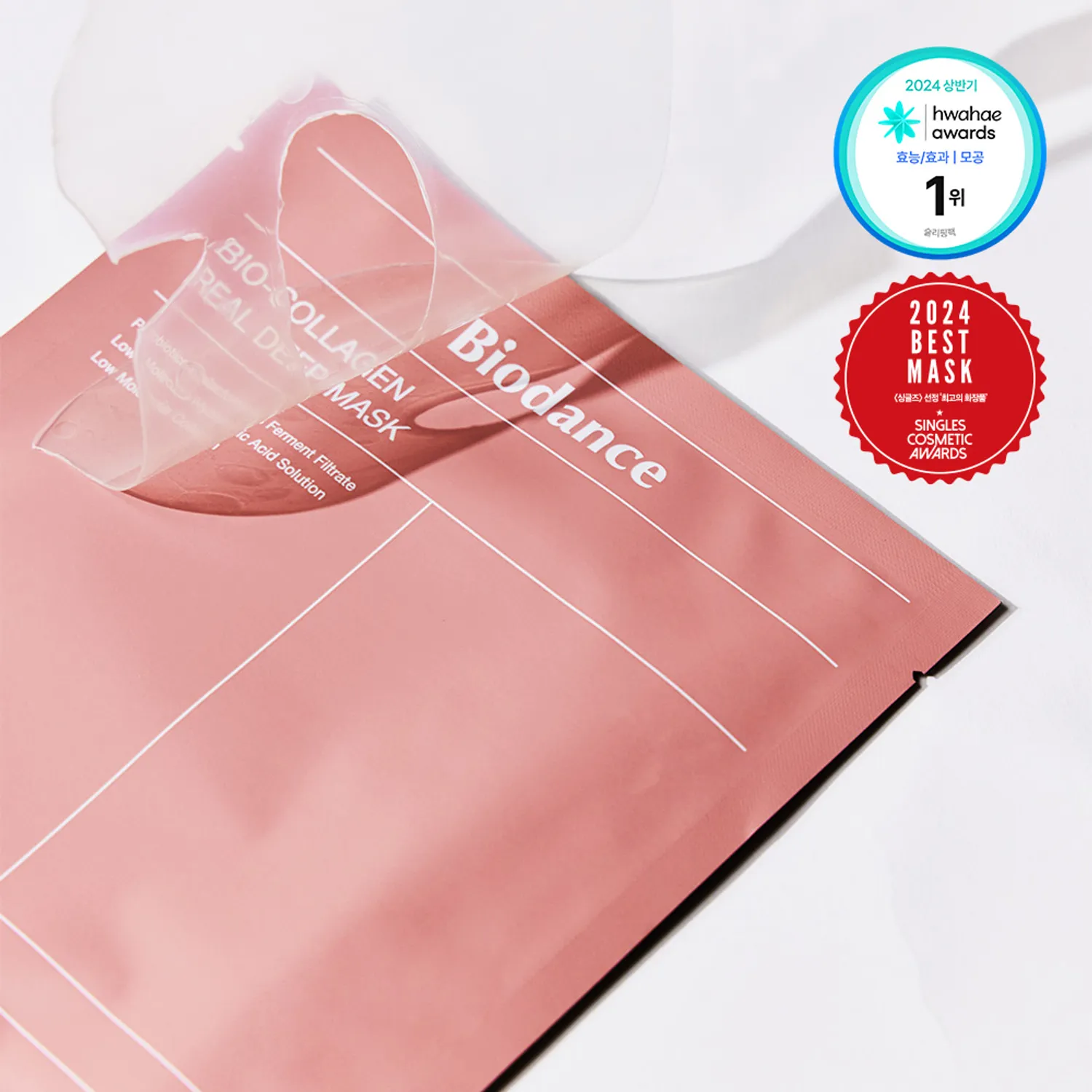
BIODANCE Bio-Collagen Real Deep Mask — the Bio-Collagen option in the 16-sheet set (photo: OLIVE YOUNG Global).
Worth knowing
- Good: the set gives you 16 hydrogel masks in that format, and you can pick the Bio-Collagen option that matches this guide's collagen discussion rather than guessing between brands.
- Good: a hydrogel mask sits close to the skin while it wears, which is the close fit described above for this format.
- Keep in mind: at CA$88.04 for 16 sheets it is a higher-priced set than a single sheet mask, and it is still a single-use product — the hydration effect is temporary, as this guide explains.
For readers in Canada, this is a Canada-shipping route: orders ship from Korea by FedEx and usually arrive in 8–11 days, with free shipping on orders over US$60. Orders over CA$20 may be taxed on delivery. This route does not currently ship to the United States.
You can see the set at OLIVE YOUNG Global here: BIODANCE Real Deep Mask 16 Sheets on OLIVE YOUNG Global — choose the Collagen Deep (Bio-Collagen) option. Use code VITAGUIDE1 for 5% off — it cannot be combined with other coupons.
Disclosure: this post contains an affiliate link. If you buy through it, I may earn a commission at no extra cost to you.


댓글
댓글 쓰기